
CCTV & Surveillance
How Many CCTV Cameras Do You Actually Need — and Where Should They Go?
Count decision points, not rooms. A small shop typically needs four to six cameras: the entrance at face height, the till, the stock room door, and the approach from outside. An office of eight to twelve staff usually needs six to ten. A camera only earns its place if you can say in one sentence what it is there to see.
Key takeaways
- Cameras belong at decision points — doors, tills, gates, stock rooms — not in the middle of rooms.
- One camera at the entrance, mounted at face height rather than up in a corner, is worth three cameras pointed at aisles.
- Wide-angle coverage and identification are different jobs. A camera cannot usually do both at once.
- Mounting height is the most common mistake: too high and you record the tops of heads and nothing identifiable.
- Write down what each proposed camera is for. Any camera you cannot describe in one sentence should be removed from the quote.
People usually arrive at a camera count the wrong way round. They walk the building, count the rooms, and ask for that many cameras. What they end up with is broad, watery coverage of everywhere and useful footage of nowhere — including, very often, a doorway shot from so high up that everyone entering is a hat and a pair of shoulders.
A better method takes about twenty minutes and needs nothing but a walk round with a notebook.
Start with the question the footage has to answer
Before counting anything, write down what you would want to know if something went wrong. In practice it is nearly always one of four things:
- Who came in and who went out, clearly enough to recognise them later.
- What happened at the point where money or stock changes hands.
- Who went into the areas customers are not supposed to enter.
- What happened outside — at the gate, the shutter, the parking, the approach.
Every camera you buy should map to one of those. If you cannot say in a single sentence what a camera is there to see, it is decoration, and you should spend the money on making one of the others better.
The decision-point method
Walk the building as though you were a stranger with bad intentions. Every place you would have to pass through, pause at, or make a choice at is a decision point. Those are your camera positions.
The main entrance
Not from the ceiling corner looking down at the mat — from roughly head height, facing the door, so that the camera sees faces square on as people walk towards it. This is the single most valuable camera in almost any building, and it is the one most often mounted wrongly.
The point of sale or the cash handling area
Angled so it covers the counter surface, the drawer and the customer, not just the back of the shopkeeper’s head. In a dispute, what matters is the note that was handed over and the hands that handled it.
The door to stock, the godown or the back office
Internal loss is far more common than dramatic break-ins, and it happens at the threshold between the public area and the private one.
The outside approach
The shutter, the gate, the parking. This is the camera that shows you what happened before anything happened — the vehicle that pulled up, the person who walked past three times.
Corridors and stairwells, if the building has more than one floor
One camera at each end of a corridor is usually better than several along it, because a corridor is a funnel and you only need to see who enters it.
Anywhere the layout creates a blind spot
Behind tall racking, around an L-shaped corner, in the recess by the fire exit. These are the places people go precisely because they cannot be seen.
Typical counts by premises
These are starting points for a conversation, not specifications. Every building argues with the table.
| Premises | Typical count | The cameras that matter most |
|---|---|---|
| Small retail shop | 4 – 6 | Entrance, till, stock room door, shutter outside |
| Larger showroom | 8 – 14 | Entrance, tills, each aisle head, stock area, rear exit, parking |
| Office, 8–12 staff | 6 – 10 | Reception, entrance, server or records room, rear exit, parking |
| Godown or warehouse | 8 – 16 | Gates, loading bay, aisle ends, high-value racking, boundary |
| Independent house | 4 – 8 | Main gate, front door, rear approach, driveway, terrace access |
| Small factory | 12 – 24 | Gates, weighbridge, stores, production floor, boundary, exits |
Notice that the counts cluster at the boundary of the property and at the points of exchange. That is not an accident — it is where the useful footage is.
Coverage and identification are two different jobs
This is the concept that changes how people think about their layout. There are broadly three things a camera can be asked to do, and one camera cannot usually do more than one of them well:
- Monitor — a wide view that tells you how many people are present and roughly what is happening. Useful for context, useless for identifying anyone.
- Recognise — enough detail to confirm that a person on screen is someone you already know.
- Identify — enough detail to identify a stranger from the footage alone, or to read a number plate. This needs the subject to fill a good part of the frame.
A single wide camera covering an entire shop floor is a monitoring camera, whatever its megapixel rating. Zooming into the footage afterwards does not create detail that the lens never resolved. If you want identification, you need a camera positioned where people come close to it — which is why the entrance camera matters so much.
Placement mistakes that waste a camera
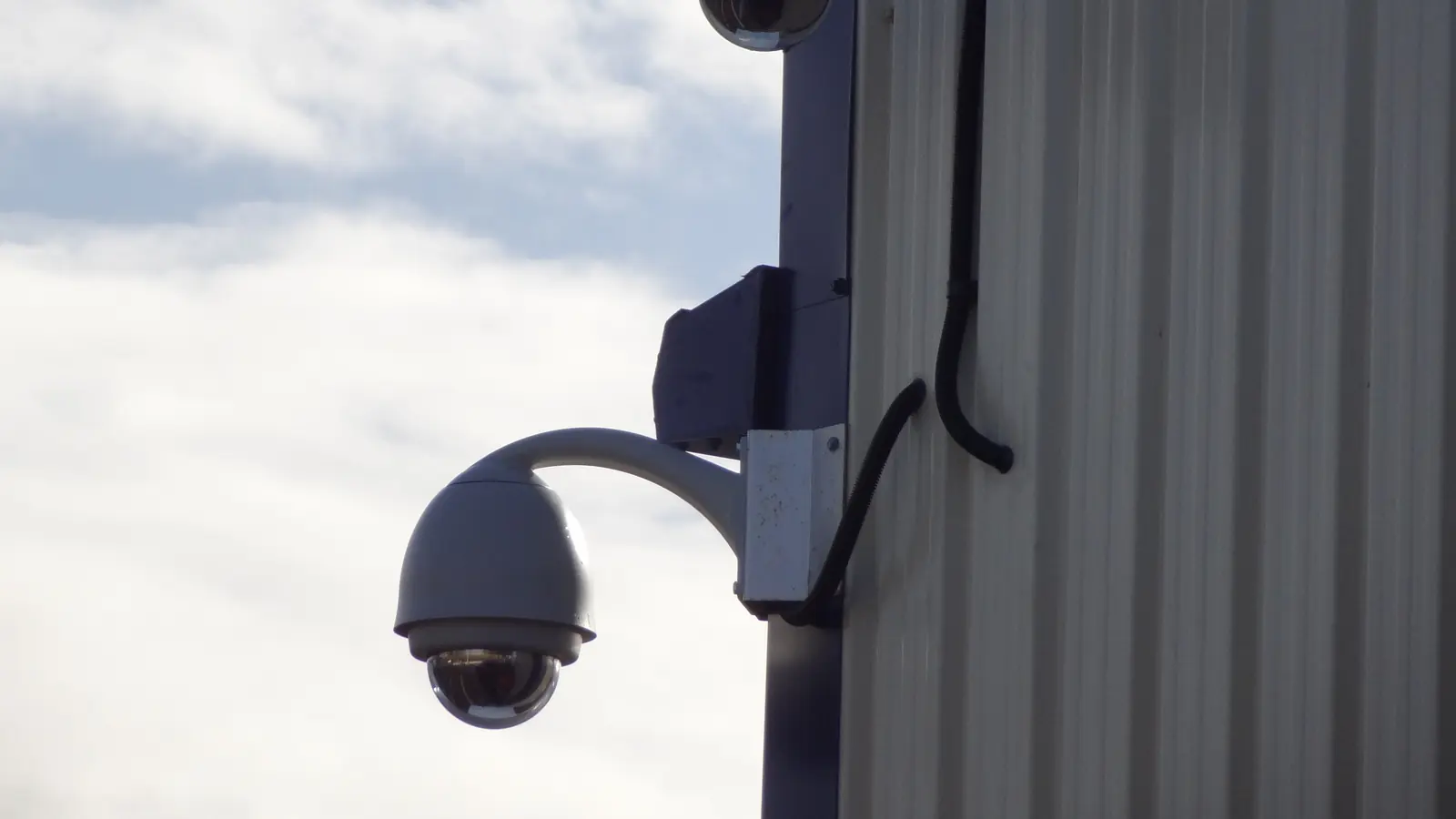
- 1Mounting too high. A camera at twelve feet looking down records the crown of a head. Eight to nine feet is high enough to be out of reach and low enough to see a face.
- 2Pointing at a window or a glass shutter. During the day the camera exposes for the bright outside and everything indoors becomes a silhouette; at night the infrared reflects straight back off the glass and blinds it.
- 3Facing directly into the afternoon sun or an unshaded light. Same problem, all year round, at the same time every day.
- 4Covering the door from behind. You get the backs of everyone leaving and nothing of anyone arriving.
- 5Placing an infrared camera close to a wall or a beam. The infrared bounces off the nearby surface and washes the whole frame out at night, which is when you need it.
- 6Mounting outdoors under no shelter and pointing slightly upward, so rain sits on the dome and every night picture is a blur of refracted light.
- 7Running the cable down the outside of the wall where it can be cut before anyone comes in.
Do not forget what happens at night
Most footage that ends up mattering was recorded in the dark, and a camera that looks excellent at 3pm can be useless at 3am. Infrared has a real, finite range, usually printed on the specification — a camera rated for twenty metres of infrared does not see anything meaningful at forty. Where there is existing light, a camera with good low-light performance in colour is often more useful than an infrared image, because a description in colour is worth far more to the police than a grey one.
A worked example: a shop on a main road
A single-shutter shop, one entrance, a counter to the right, a stock room at the back, and parking in front. Five cameras:
- One inside the entrance at head height, facing the door, for identification of everyone who comes in.
- One over the counter, angled to see the drawer, the counter surface and the customer’s hands.
- One at the stock room door, covering the threshold.
- One wide camera covering the shop floor for context.
- One outside under the shutter box, covering the frontage and the parking.
That is a system where every camera has a job. Adding three more pointed at aisles would raise the cost and the storage requirement, and would not answer any question that the first five do not already answer.
Have someone walk it with you
The whole exercise takes twenty minutes on site and saves a great deal afterwards. Palm Vision Technology does this survey free anywhere in Udaipur city and the surrounding district: we walk the building with you, agree what each camera is there to see, and quote to that. If the honest answer is that you need fewer cameras than you expected, that is what we will tell you.
Questions people ask about this
The follow-up questions we get most often on this subject, answered plainly.
How many CCTV cameras does a small shop need?
Usually four to six. One at the entrance mounted at head height for identifying faces, one over the till covering the counter and the drawer, one at the stock room door, one wide camera for context on the shop floor, and one outside covering the shutter and the frontage. Cameras beyond that tend to add cost and storage without answering a new question.
What is the best height to mount a CCTV camera?
Around eight to nine feet for cameras meant to identify people. That is high enough to be out of easy reach and low enough to capture a face rather than the top of a head. Cameras mounted at twelve feet or higher are useful for seeing that something happened, but rarely for identifying who did it.
Where should CCTV cameras be placed in a house?
At the main gate, the front door, the rear or side approach, and the driveway, with one covering access to the terrace if it can be reached from a neighbouring roof. Focus on the boundary and the entry points rather than on internal rooms — most residential incidents are decided at the perimeter.
Is one high-resolution camera better than several cheaper ones?
Not usually, because coverage and identification are different jobs. A single wide camera, however high its resolution, produces a monitoring view in which faces are too small to identify. A better system puts one camera where people pass close to it for identification and uses wider, cheaper cameras for the rest.
Why do my CCTV cameras look fine in the day and useless at night?
Most commonly the infrared range is being exceeded, or the infrared is reflecting off something close by — a wall, a beam, a glass door — and washing out the frame. Cameras pointed at windows suffer badly from this. Where there is existing lighting, a camera with strong low-light colour performance is often more useful at night than infrared.
Can you tell me how many cameras I need without visiting?
We can give you a rough range from a description, but the count is decided by sightlines, entrances and blind spots that only show up on site. Palm Vision Technology surveys premises across Udaipur free of charge and without obligation. Call +91 94141 61245 to arrange it.